Loading...
May 5, 2026
The Hidden Cost of Manual ATO Document Processing for Australian Accounting Firms and How Automation Fixes It
Lodge Pro•Blog•5 min read
Manual ATO document processing costs Australian accounting firms far more than the time. Repetitive portal logins, file handling, and manual redaction create hidden compliance, security, and productivity risks. ATO document processing automation reduces errors, strengthens governance, and frees teams to focus on higer-value work.
Table of Contents
1. Introduction: Why ATO Document Processing Is Still a Manual Burden for Accounting Firms
2. The “Invisible” Workflow That Consumes Your Week
3. Direct Costs of Manual ATO Document Processing
4. Hidden Risks in Manual ATO Correspondence Handling
5. Why ATO Automation Is Growing Across Australian Accounting Firms
6. How Hyperdoc Automates the ATO Workflow
7. The Business Impact of Automating ATO Document Processing
8. FAQs About ATO Automation for Accounting Firms
9. Conclusion: Moving Beyond Manual ATO Processes
Why ATO Document Processing Is Still a Manual Burden for Accounting Firms
Most Australian accounting firms still spend hours every week managing ATO document processing manually. Logging into the ATO portal, downloading correspondence, renaming files, redacting TFNs, emailing clients, and filing documents may seem routine - but together these tasks consume a surprising amount of time.
During busy periods like quarterly instalment notice cycles, many practices report several hours per day spent simply managing ATO correspondence. What often goes unnoticed is the broader impact: inefficient workflows, inconsistent client communication, and increased compliance risk.
As ATO correspondence volumes grow and compliance expectations rise, ATO automation in Australia is rapidly becoming a necessity rather than a convenience. Industry reports show that firms are increasingly adopting specialised ATO document management software to streamline workflows, reduce manual handling, and improve data security.
This article explores the true cost of manual ATO document processing and how software like Hyperdoc helps Australian accounting firms automate ATO correspondence processing and eliminate bottlenecks while improving governance and client experience.
The “Invisible” Workflow That Consumes Your Week
For many firms, ATO portal workflow tasks are so routine that they often go unnoticed. But taken together, they create one of the most time-consuming administrative processes in modern accounting practices.
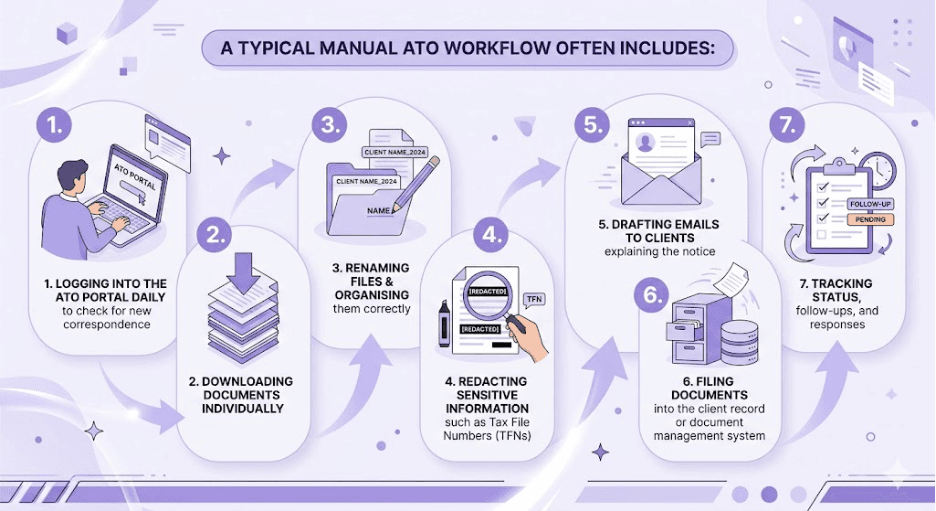
Multiply these steps across hundreds or thousands of client entities, and the workload quickly escalates.
The problem is compounded by the way ATO correspondence is distributed. Documents may arrive through multiple channels - including postal mail, client MyGov accounts, email, or the ATO agent portal - making it difficult for firms to maintain a single, reliable workflow.
Without a structured process, documents can be missed, delayed, or incorrectly handled.
Direct Costs You Can Measure
Lost Time
The most obvious cost of manual ATO document processing is time. Administrative staff and accountants spend hours completing repetitive tasks that add little value to the practice.
Lost productivity
Downloading, renaming, and filing documents takes significant time. During quarterly reporting periods - when PAYG instalment notices and IAS statements arrive in bulk—the workload can spike dramatically decreasing the productivity of your staff.
Rework and errors
Manual workflows increase the chance of:
Incorrect file naming
Documents being filed to the wrong entity
Duplicate downloads
Missed correspondence
Fixing these mistakes creates additional work and slows down the entire practice.
Client communication delays
When ATO notices take hours or days to process, clients may receive important information late. In the case of PAYG instalment notices or activity statements, delays can impact decision-making and compliance deadlines.
Hidden Costs You Can’t Ignore
Beyond time and productivity, manual ATO document processing creates several hidden risks that many firms underestimate.
Data security risks
Handling sensitive information manually - particularly TFN redaction - creates opportunities for mistakes.
A single unredacted TFN sent via email can expose your firm to:
Privacy breaches
Reputational damage
Compliance consequences
As data security expectations increase, firms need systems that minimise the risk of human error in handling confidential client information.
Compliance and audit challenges
Without a structured system, it can be difficult to track:
Who reviewed the document
Who approved client communication
When the document was sent or filed
This lack of visibility can become problematic during compliance reviews or internal audits.
Client experience issues
Inconsistent communication is another hidden cost. Mnual emails written by different staff members often vary in tone, clarity, and detail. Clients may receive confusing explanations of ATO notices, leading to additional questions and increased phone support.
The Growing Demand for ATO Automation in Australia
The accounting technology landscape in Australia is evolving rapidly.
Industry research shows that ATO document automation is now one of the fastest-growing areas within accounting practice technology. The Practice Protect Australian Cloud Accounting Apps Report 2025–26 even describes ATO document processing as a “category within a category” due to the scale of efficiency gains available.
Firms are no longer satisfied with generic document management systems. Instead, they are seeking solutions designed specifically for the ATO correspondence workflow, including automation, integration, and secure data handling.
The trend reflects a broader shift toward accounting workflow automation in Australia, where practices prioritise tools that eliminate repetitive tasks and allow teams to focus on higher-value advisory work.
How Hyperdoc Fixes the Manual ATO Problem
Hyperdoc was designed specifically to address the inefficiencies in ATO document processing for Australian accounting firms.
Instead of relying on manual downloads and email chains, Hyperdoc automates the entire process - from document capture to client communication.
Direct ATO integration
Hyperdoc connects directly with the ATO to retrieve correspondence automatically. This eliminates the need to log into the portal and download documents manually. This will result in fewer missed notices and significantly reduced administrative workload.
Automatic TFN redaction
Sensitive data such as Tax File Numbers is automatically redacted before documents are shared with clients. This reduces the risk of accidental data exposure and strengthens your firm’s data protection practices.
Structured review workflows
Hyperdoc introduces clear, structured workflows that route documents through defined review and approval steps.
This ensures:
Consistent processing
Reduced errors
Full visibility into who handled each document
Faster client communication
Client communications can be generated automatically using customisable templates stored within the system for all document types that reflect your firm’s branding and messaging. Instead of drafting emails from scratch, your team can customise and send communications quickly and consistently.
Audit-ready document management
Every action in Hyperdoc is logged with a timestamp and user record, creating a complete audit trail. This provides the governance and transparency that the ATO and modern accounting firms require for compliance and internal oversight.
Enterprise-grade security
Hyperdoc follows security practices aligned with ISO 27001 controls and integrates with the ATO ecosystem, ensuring a trusted and compliant workflow for sensitive tax information.
Why Automation Matters More Than Ever
ATO correspondence continues to increase in volume and complexity.
At the same time, accounting firms face growing pressure to:
Improve efficiency
Maintain strong compliance controls
Deliver better client service
Manual workflows simply cannot keep pace with these demands.
By implementing ATO correspondence processing automation in Australia, practices can reclaim significant amounts of time while reducing operational risk. Instead of spending hours on administrative tasks, teams can focus on advisory services, client strategy, and higher-value work.
Ready to Stop Losing Hours to ATO Admin?
Manual ATO document processing costs accounting firms far more than just time. It introduces operational inefficiencies, compliance risk, and inconsistent client communication. With Hyperdoc, Australian accounting firms can automate the entire workflow - from document capture to secure client delivery - while maintaining full audit visibility and governance. If your practice is still relying on manual processes, now is the time to upgrade your workflow.
Book a demo to see how Hyperdoc can streamline your ATO document management end-to-end.
Frequently Asked Questions
Q1: Is Hyperdoc only for ATO correspondence?
ATO correspondence is currently the primary use case, as it represents one of the most time-consuming workflows in accounting practices.
Q2: How does Hyperdoc protect client data?
Hyperdoc uses direct ATO ingestion, automated TFN redaction, and security controls aligned with ISO 27001 industry standards to minimise exposure to sensitive information.
Q3: How quickly can firms implement Hyperdoc?
Most practices can begin using the system within days once the sign-up process is complete. Contact us to get started today.