Loading...
May 7, 2026
Late BAS Payment in Australia: What to Do If You Miss the Deadline
Lodgepro•Blog•5 min read

Late BAS Payment in Australia: What to Do If You Miss the Deadline
A late BAS payment in Australia can lead to penalties and interest, but it is usually manageable if handled quickly. This guide explains what happens when you miss a BAS deadline, how to lodge and pay late, and practical steps to minimise ATO penalties and stay compliant.
Table of Contents
1. Introduction
2. What Is a BAS and When Is It Due?
3. What Happens If Your BAS Payment Is Late?
4. Missed a BAS Deadline? Step-By-Step to Get Back on Track
5. How to Prevent Late BAS Payments in the Future
6. Common Questions From Small Business Owners
7. How LodgePro Can Help
Running a small business in Australia comes with a long list of responsibilities, and tax compliance is one of the most important. Among these obligations is lodging and paying your Business Activity Statement (BAS) on time. However, between managing staff, customers, cash flow, and daily operations, it’s not uncommon for a BAS deadline to slip through the cracks.
If you’ve missed a BAS deadline or made a late BAS payment, don’t panic. Many Australian businesses face this situation at some point, and the Australian Taxation Office (ATO) provides ways to resolve it. The key is to act quickly and take the right steps to minimise penalties and get back on track.
This guide explains what BAS is, what happens if you lodge or pay late, and practical steps you can take to resolve the issue and prevent it from happening again.
What Is a BAS and When Is It Due?
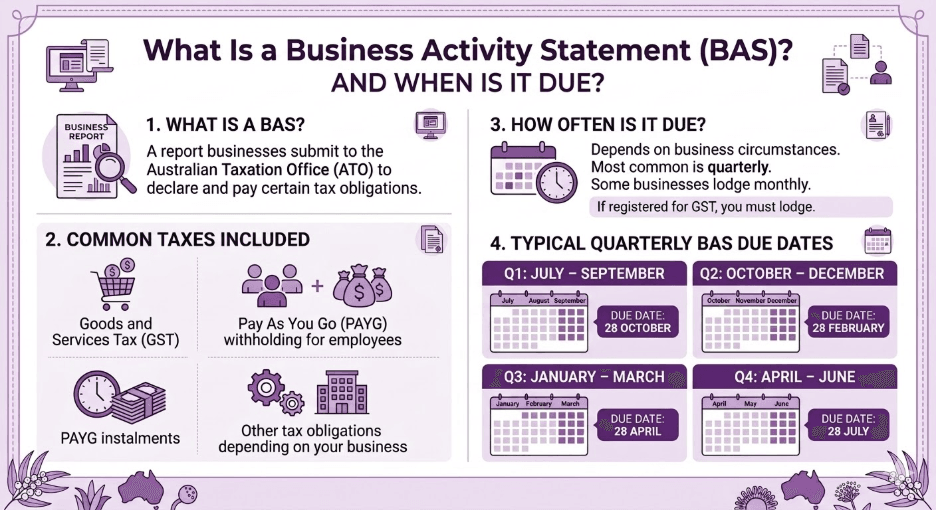
A BAS reports key tax obligations such as GST, PAYG withholding, and PAYG instalments. Most small businesses lodge BAS either quarterly or monthly.
Standard BAS due dates include:
- Quarterly BAS: 28 October, 28 February, 28 April, 28 July
- Monthly BAS: 21 days after the end of each month
If you lodge through a registered BAS or tax agent, you may receive extended due dates.
Always confirm your due date through ATO Online Services or on the BAS notice itself. If the due date falls on a weekend or public holiday, the deadline usually moves to the next business day.
What Happens If Your BAS Payment Is Late?
When you miss a BAS deadline, the ATO treats lodgment and payment as two separate issues:
- Lodging the BAS form late
- Paying the tax owed late
Both may attract penalties or interest.
Failure to Lodge (FTL) Penalty
If you lodge your BAS after the due date, the ATO may apply a Failure to Lodge (FTL) penalty.
FTL penalties are calculated using penalty units, which increase depending on:
- The size of your business
- How long the BAS remains outstanding
Small businesses usually face lower penalties than large corporations, but the penalty can still increase over time if the BAS is not lodged.
The good news is that the ATO may reduce or cancel (remit) penalties if:
- You have a strong compliance history
- The delay was due to circumstances outside your control
- You act quickly to resolve the issue
General Interest Charge (GIC) on Late Payments
If your BAS is lodged but not paid by the due date, the ATO will apply a General Interest Charge (GIC).
Key points about GIC:
- It accrues daily
- It continues until the debt is fully paid
- It applies even if you have arranged a payment plan
Because interest compounds over time, resolving the debt quickly helps minimise the total amount you owe.
Even if you cannot pay immediately, lodging the BAS quickly prevents additional Failure to Lodge penalties from accumulating.
Director Penalty Risks (Companies)
For businesses operating as companies, directors need to be aware of additional risks.
Unpaid obligations such as:
- PAYG withholding
- Superannuation guarantee liabilities
can lead to Director Penalty Notices (DPNs).
While GST debts themselves typically do not trigger a DPN, unpaid tax obligations overall can increase scrutiny from the ATO. Ignoring tax debts may lead to stronger enforcement actions, including recovery proceedings.
The best approach is always to engage early with the ATO and demonstrate that you are actively resolving the issue.
Missed a BAS Deadline? Step-By-Step to Get Back on Track
If you realise your BAS is late, follow these steps to correct the situation as quickly as possible.
1. Lodge the BAS Immediately – Even If You Can’t Pay Yet
Your first priority should be lodging the BAS.
Submitting the form:
- Stops additional Failure to Lodge penalties
- Shows the ATO you are cooperating
- Provides clarity on the amount owed
You can lodge BAS through:
- ATO Online Services
- Accounting software such as Xero or MYOB
- A registered BAS or tax agent
Even if payment is not possible right away, lodging promptly improves your position.
2. Set Up a Payment Plan
If you cannot pay the full BAS amount, the ATO allows businesses to set up payment plans.
Payment plans allow you to:
- Pay the debt in instalments
- Spread payments over time
- Avoid stronger recovery action
You can arrange a plan through ATO Online Services or by contacting the ATO directly.
Choose a realistic repayment schedule to ensure you can meet the commitments.
3. Request Remission (Where Appropriate)
If you have received penalties or interest charges, you may request remission.
The ATO may consider reducing or cancelling penalties if the delay occurred due to circumstances such as:
- Illness
- Natural disasters
- Technical system failures
- Other unexpected disruptions
When requesting remission, provide:
- A clear explanation
- Supporting evidence where possible
- Details of the steps taken to prevent future issues
Businesses with a strong compliance record are more likely to receive favourable consideration.
4. Correct Errors With a Voluntary Disclosure
If you discover a mistake on a previous BAS, correct it as soon as possible.
Common BAS errors include:
- Overclaiming input tax credits
- Underreporting GST on sales
- Misreporting PAYG withholding
The ATO generally treats voluntary disclosures more favourably than errors discovered during audits.
Smaller corrections can often be made in your next BAS, while larger errors may require an amended BAS.
5. Get Support From a Bookkeeper, Accountant or Lawyer
If multiple BAS periods are outstanding or the debt has grown significantly, professional help may be valuable.
A qualified bookkeeper or accountant can:
- Reconcile your accounts
- Lodge outstanding BAS statements
- Negotiate payment arrangements
- Request penalty remission
Professional support often speeds up the process and helps ensure your records are accurate going forward.
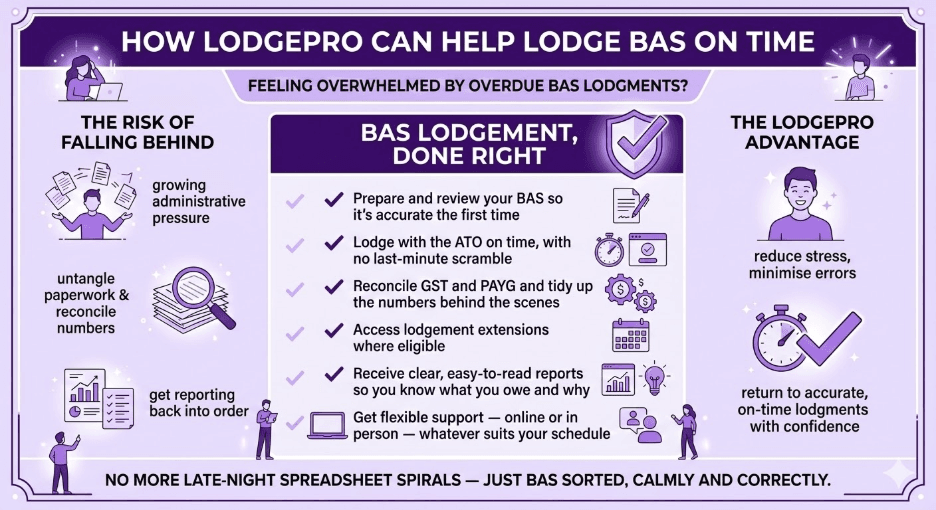
If multiple BAS periods are overdue or debts are significant, LodgePro can help fast‑track compliance and negotiations with the ATO. Visit us to get your business accounts back on track.
Frequently Asked Questions
Q1: Should I lodge my BAS if I can’t pay?
Yes. Lodging stops Failure to Lodge penalties and shows the ATO you are actively managing the issue.
Q2: How big are BAS penalties in Australia?
Penalties depend on how late the BAS is lodged and the size of the business, with amounts increasing over time.
Q3: Can the ATO remove BAS penalties?
Yes. The ATO may remit penalties if you have a good compliance history or the delay was beyond your control.
Q4: What if I made a mistake on a previous BAS?
You can correct errors through a voluntary disclosure or by amending your BAS, depending on the size of the error.
Q5: Is missing one BAS a big deal?
One missed BAS is usually manageable if resolved quickly, but repeated delays can lead to higher penalties and ATO enforcement.