Loading...
October 14, 2026
Best ATO Document Processing Software for Small Accounting Firms in Australia
Hyperdoc Team •Blog•5 min read
What is the best ATO correspondence management software for small businesses in Australia? Many accounting firms don't think much about this until they see how much time their current process costs them.
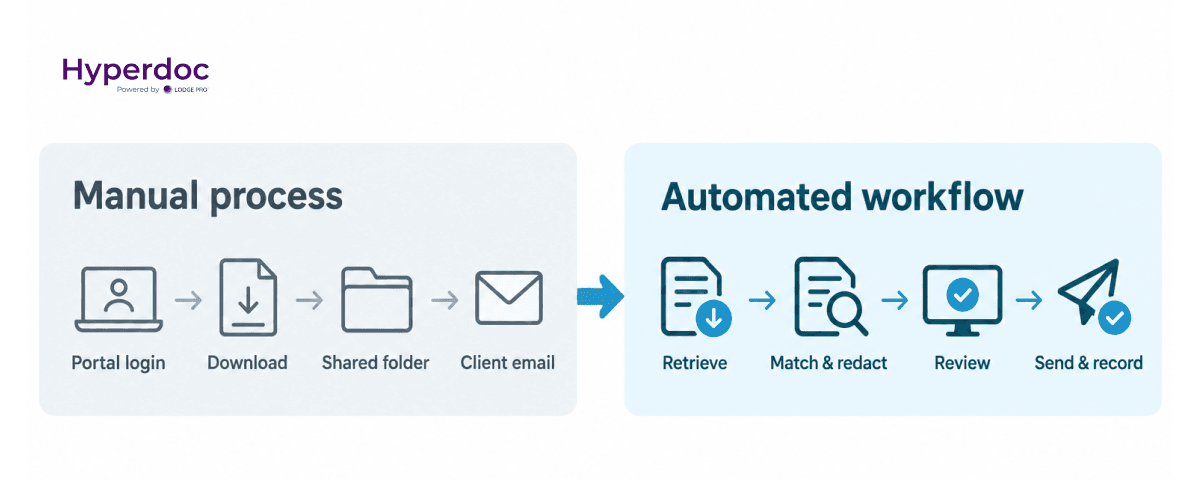
Picture a typical Tuesday morning. A staff member is already 45 minutes into their weekly routine. They log in to the ATO portal, open each client record one at a time, download correspondence manually, save it to a shared drive with an inconsistent folder structure, then forward documents by email. There may be no clear record of who sent what, or when.
Multiply that across 200 or 300 client entities and a practice can easily spend 15 to 20 staff hours a week on work that adds little real value.
For many small Australian accounting firms, this is still the norm. The manual approach is not only slow. It can also create genuine compliance risks. Documents may be sent to clients without Tax File Number (TFN) redaction, delivery may not be confirmed, and there may be no reliable audit trail if questions arise later.
Choosing the right ATO correspondence management software is not about finding the most feature-heavy platform. It is about finding a solution that meets your practice's practical needs today.
This article covers five key requirements, compares the main approaches firms use, from manual handling to purpose-built automation, and explains how platforms such as Hyperdoc, powered by LodgePro, are changing how practices manage ATO notices and correspondence.
The five things your practice needs before evaluating an ATO correspondence tool
Many firms start the process backwards. They watch product demonstrations and compare feature lists before clearly defining the problem they are trying to solve.
Start with your non-negotiables, and the selection process becomes much simpler.
Secure ATO portal connectivity and automatic retrieval
Direct ATO integration lets software use your practice’s registered tax agent credentials to automatically retrieve correspondence, without staff needing to log in to the ATO portal for every client.
Your practice will need current client authorities in place, along with the appropriate Access Manager permissions. In particular, the Clients (View) permission provides access to client mail and communication history.
At a minimum, a serious ATO document retrieval tool should extract correspondence overnight across your client base. If a platform still relies on manual document uploads, it may help with storage, but it does not solve the retrieval issue.
TFN redaction and information security
Automatic TFN redaction should be a core requirement before documents are shared with clients. Under the Privacy Act and the ATO’s TFN Guidelines, tax practitioners have clear responsibilities for how they handle and disclose tax file numbers.
The ATO’s guidance on credential security also highlights the importance of individual accounts, multi-factor authentication and access based on staff responsibilities.
ISO 27001 certification is a recognised benchmark for information security management. The ATO does not require it, but any credible provider handling sensitive client information should be able to demonstrate its security practices and certifications when asked.
Together, TFN redaction, strong authentication, sensible access controls and robust data security help protect your practice, your clients and your professional registration.
Clear review workflows, Xero synchronisation and audit-ready records
Documents that simply land in a shared inbox can quickly create more work than they save. Without clear ownership or status tracking, correspondence can sit untouched, be reviewed twice or be missed altogether.
A structured workflow means each document appears in the right client queue, has an assigned owner and a clear status, and can be escalated when action is needed.
Xero synchronisation also matters. It reduces duplicate client data entry and helps keep information consistent across systems. Every action taken on a document, from retrieval through to client delivery, should be time-stamped and recorded in a complete audit trail. That makes future compliance checks far less painful.
The three approaches accounting firms use, and where they fall short
ATO correspondence processes generally sit on a spectrum, from fully manual handling through to automated systems. Knowing where your firm currently sits can help you assess the real cost of staying there.
1. Manual ATO portal downloads
The manual process is familiar. Staff log in, open each client record, download documents individually, save them to a shared drive and send them by email from a personal or firm account.
For a practice with around 300 active clients, this can take 15 to 20 staff hours a week across the team.
As the Clarit-e case study referenced later in this article shows, a mid-tier practice processing about 10,000 tax returns each year was spending two to four weeks handling a single batch of ATO notices from start to finish.
The compliance risks are also clear. There is no automatic TFN redaction, no confirmation that a client received the document and no dependable audit trail if receipt is later disputed.
2. Generic document management systems
Platforms such as SharePoint can solve the storage problem, but they do not solve retrieval or workflow management.
They require staff to upload documents manually, don't connect directly to the ATO portal, and usually don't include automatic TFN redaction. You may be able to add redaction through custom automation or third-party add-ons, but that adds setup and configuration costs.
Microsoft 365-based systems can appear affordable per user, but building a useful review workflow on top of them may require significant configuration.
Xero and MYOB also don’t natively retrieve ATO correspondence. Their ATO connections support lodgements and reporting, not incoming notices, assessments, or other correspondence.
3. Purpose-built ATO correspondence platforms
Purpose-built platforms are designed to handle the whole process. They connect to the ATO, automatically retrieve documents, categorise them by type, redact TFNs, and send documents through structured review and approval workflows.
Choosing ATO correspondence management software for a small Australian practice
ATOmate uses tailored pricing based on document volume, so you will need to speak with the provider before making a meaningful cost comparison.
Both are established options with ATO correspondence management capabilities suited to Australian accounting practices.
Where Hyperdoc fits
Hyperdoc connects directly to the ATO through LodgePro. It retrieves correspondence overnight, applies TFN redaction before documents leave the platform and routes documents into structured review queues.
Client records can synchronise from Xero, reducing duplicate data entry and helping incoming ATO documents reach the right entity. Hyperdoc’s published security documentation states that the platform holds ISO 27001 certification, an important consideration for firms handling sensitive financial correspondence.
Once staff review and approve a document, they can send it using firm-branded email templates to provide clients with a more consistent experience.
Pricing across the category
The clearest public pricing benchmark in the category is GovReports, which ranges from $636 to $3,528 a year depending on client volume.
Hyperdoc currently offers an introductory price of $100 per month plus GST for the first 12 months, with no setup fee and no per-document charges during that period. Confirm current pricing and availability directly with the vendor, as introductory offers can change.
ATOmate uses volume-based pricing, so a direct comparison will require a tailored quote.
When comparing platforms, ask for the full three-year cost, including setup, migration, integrations and ongoing support. Once you account for the staff time absorbed by manual handling, a purpose-built platform can compare favourably on a per-client basis.
What the workflow can look like in practice
A typical morning with purpose-built ATO software
At 8 am, the practice manager opens the dashboard. Overnight retrieval has already collected 43 new ATO notices across the client base. The system has categorised and allocated notices of assessment, BAS confirmations, and debt notices.
TFNs have already been redacted. Each document is in the correct client queue and ready for review.
The reviewer checks the document, approves it and sends it using a firm-branded email template. In many cases, the process takes less than five minutes per client.
Compared with the weekly portal routine described earlier, the difference is significant. It changes the way the work is handled from the start.
The numbers behind faster correspondence workflows
A Clarit-e case study involving a mid-tier Australian practice processing approximately 10,000 tax returns each year found that ATO correspondence handling dropped from two to four weeks to fewer than four days after structured workflow automation was introduced.
The practice also saved more than $60,000 a year on paper, printing, and postage. More importantly, managers could redirect time previously spent on administration to advisory work.
That is the value of structured ATO correspondence automation. It gives firms more than faster processing. It gives experienced staff more time for work that clients value.
Your practical buyer checklist and next steps
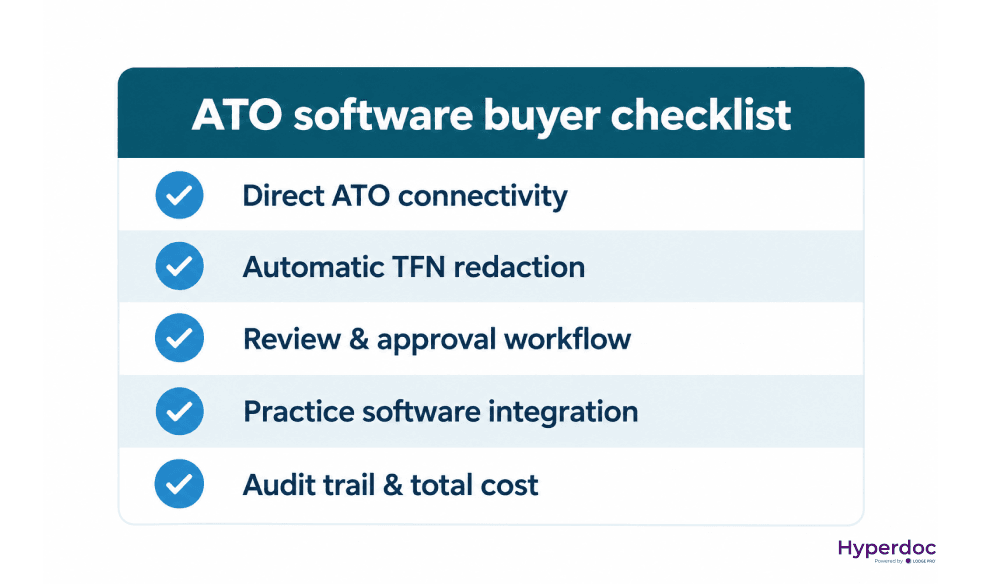
Before committing to a platform, ask each shortlisted vendor these eight questions.
- Does the platform connect directly to the ATO, or does it rely on manual document uploads?
- Is TFN redaction applied automatically before documents are shared with clients?
- Does it provide structured review and approval workflows with clear status tracking?
- Does it integrate natively with Xero or your practice management system?
- Is the platform ISO 27001 certified, or does it meet an equivalent security standard? Is data stored in Australia?
- Does it maintain a full audit trail for every document action?
- What is the total three-year cost, including setup, migration and support?
- Can you trial the platform or test retrieval using a live client batch?
A strong platform should be able to answer all eight questions clearly.
Moving from evaluation to implementation
Shortlist one or two purpose-built ATO correspondence platforms using the checklist above, then request a live demonstration based on your document volume and client mix.
Ask each provider to show you the migration path from your existing process, not just the features of the new system. Also ask about trial periods and parallel-run options. These can help your team build confidence before the new system becomes your main way of handling correspondence.
Start with one client cohort, learn from the rollout and then expand across the practice.
Choosing the right fit for your practice
So, what is the best ATO correspondence management software for small Australian businesses?
The honest answer is the platform that meets your practice’s core requirements: direct ATO connectivity, automatic TFN redaction, structured review workflows, Xero synchronisation, and audit-ready document storage.
Manual processes and generic document management systems can each solve part of the problem. Neither, however, closes the efficiency and compliance gap that purpose-built ATO correspondence platforms are designed to address.
With the right system, staff can spend less time downloading and forwarding documents. Clients receive correspondence promptly and professionally. Compliance reviews become quicker and easier to manage.
If you are ready to move from research to action, Hyperdoc is worth adding to your shortlist.
Contact the Hyperdoc team to book a live demonstration and see overnight ATO retrieval in action using a real client batch from your practice.