Loading...
July 8, 2026
Why TFN Redaction Software Matters for Accounting Firms in Australia
Hyperdoc Team•Blog•5 min read
Why Tax File Number Redaction Software Matters for Accounting Firms in Australia
Tax file number redaction helps accounting firms automatically detect and remove Tax File Numbers from ATO documents. This reduces compliance risk, prevents data exposure, and improves operational efficiency. Automated redaction ensures secure document workflows while meeting Privacy (TFN) Rule 2015 requirements in Australia.
Table of Contents
Why TFN Redaction Matters for Accounting Firms
The Growing Risk of TFN Exposure
The Hidden Cost of Manual TFN Redaction
Compliance Is About More Than Security
Why Secure Accounting Workflows Need Automation
How Hyperdoc Simplifies TFN Compliance
Building Client Trust Through Better Data Protection
Strengthen Security and Compliance with Automated TFN Redaction
Why TFN Redaction Matters for Accounting Firms
Accounting firms are entrusted with some of the most sensitive information their clients possess. From tax returns and notices of assessment to ATO correspondence and compliance documents, accountants routinely handle confidential financial data that requires the highest level of protection.
Among the most sensitive pieces of information contained within these documents is the Tax File Number (TFN). Many practices continue to face a significant operational challenge: manually identifying and removing TFNs from ATO documents before they are shared, stored, or distributed through client-facing systems.
As firms continue to embrace digital workflows, cloud document management, and client portals, the need for secure accounting workflows and automated sensitive data protection has never been greater.
This is where automated tax file number redaction software becomes essential.
The Growing Risk of TFN Exposure
Modern accounting firms process hundreds, if not thousands, of ATO documents every month. These documents often need to be:
- Reviewed internally
- Stored in document management systems
- Uploaded to client portals
- Shared with team members
- Sent directly to clients
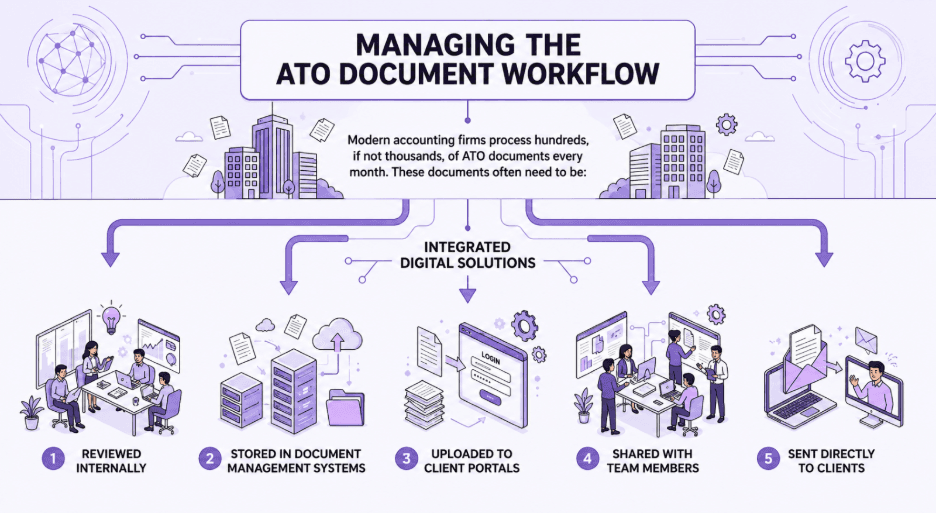
Every time a document containing a TFN is accessed, stored, or transmitted, there is a potential risk of exposure.
While many firms have implemented cybersecurity measures such as multi-factor authentication, encrypted storage, and secure portals, one critical vulnerability often remains: documents that still contain visible TFNs.
A common assumption is that if a document is stored in a secure client portal, there is no issue. However, the Privacy (Tax File Number) Rule 2015 places obligations on TFN recipients, including accounting firms and registered tax agents, to take reasonable steps to protect TFN information from unauthorised access, use, disclosure, or misuse.
The challenge is not simply where documents are stored. It is ensuring that unnecessary TFN information is not exposed in the first place.
The Hidden Cost of Manual TFN Redaction
Most accounting firms understand the importance of redacting TFNs before documents are distributed. The problem is that the process is often manual.
For many practices, the workflow looks something like this:
- Download ATO correspondence.
- Open the document.
- Locate the TFN.
- Apply a redaction tool.
- Save the document.
- Upload it to a document management system or client portal.
- Send it to the client.
This process may only take a minute or two per document, but when multiplied across hundreds of documents every week, the administrative burden becomes substantial.
More importantly, manual processes introduce risk.
Human errors are inevitable. A staff member may:
- Miss a TFN during review.
- Accidentally upload the wrong version of a document.
- Forget to redact a page.
- Send an unredacted document to a client.
It only takes a single oversight to create a privacy incident.
As accounting firms continue to face staffing pressures and increasing compliance obligations, relying on manual redaction processes is becoming increasingly difficult to justify. This is why many firms are now investing in automated tax file number redaction software to improve efficiency and reduce compliance risk.
Compliance Is About More Than Security
The Privacy (Tax File Number) Rule 2015 requires organisations that receive TFNs to take reasonable steps to protect that information.
This includes protecting TFNs against:
- Unauthorised access
- Unauthorised disclosure
- Loss
- Misuse
- Modification
The legislation also requires TFN information to be securely destroyed or permanently de-identified when it is no longer required.
For accounting firms, this means implementing processes that minimise unnecessary exposure of TFNs throughout the document lifecycle.
Redaction plays a critical role in achieving this objective.
When TFNs are removed before documents are stored in portals, document management systems, cloud environments, or shared with clients, firms significantly reduce the risk associated with handling sensitive information.
More importantly, automated redaction demonstrates a proactive approach to compliance and data governance.
Why Secure Accounting Workflows Need Automation
Automation has transformed many aspects of modern accounting, from bookkeeping and payroll to tax preparation and document management.
Yet TFN redaction remains a surprisingly manual task in many firms.
This creates a disconnect in otherwise streamlined workflows.
Consider the typical ATO document processing journey:
Documents are retrieved digitally.
Client records are matched automatically.
Documents are categorised and filed electronically.
Notifications are triggered automatically.
Then someone manually opens every document to remove TFNs.
The manual step becomes a bottleneck that slows down the entire process.
Automated TFN redaction eliminates this inefficiency by ensuring sensitive information is removed before documents enter your firm's workflow.
The result is:
Faster document processing
Reduced administrative effort
Lower compliance risk
Greater consistency
Improved staff productivity
For firms processing large volumes of ATO correspondence, the time savings alone can be significant.
How Hyperdoc Simplifies TFN Compliance
Hyperdoc was designed specifically to help accounting firms automate ATO document processing while maintaining the highest standards of security and compliance.
One of the most valuable features built into the platform is automatic TFN redaction.
Instead of requiring staff to manually review and edit every ATO document, Hyperdoc automatically identifies and redacts TFNs before documents are delivered into your workflow.
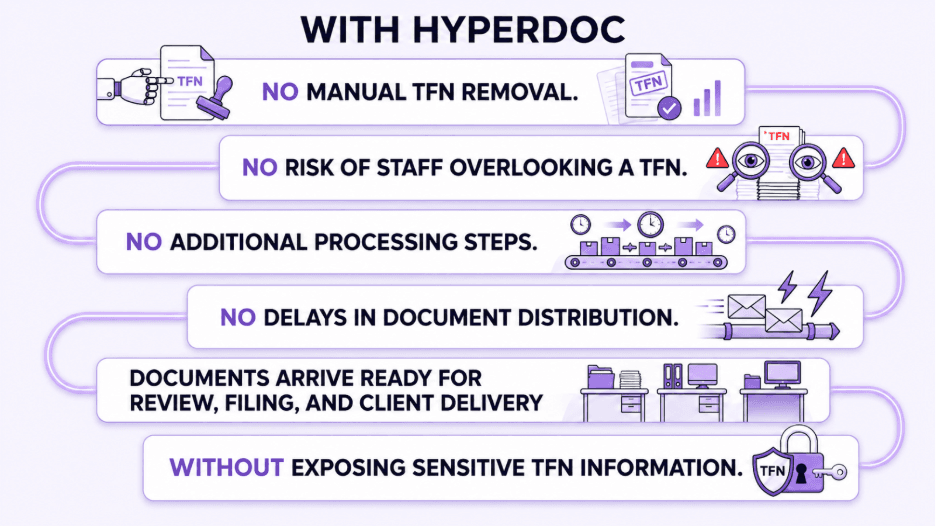
By embedding TFN protection directly into the document processing workflow, Hyperdoc helps firms implement secure accounting workflows without adding complexity.
And you can confidently distribute and archive ATO correspondence knowing that TFN information has already been removed.
This approach aligns with best-practice data minimisation principles and strengthens overall sensitive data protection across the firm.
Building Client Trust Through Better Data Protection
Clients expect their accountants to safeguard their financial information.
In today's environment, trust is closely linked to how firms manage data security and privacy.
A data breach involving TFNs can damage client relationships, impact a firm's reputation, and create significant compliance concerns.
Implementing automated TFN redaction demonstrates a commitment to protecting client information and adopting modern risk management practices.
It shows clients that your firm takes privacy seriously and has invested in systems designed to minimise exposure of sensitive data.
For many firms, this has become an important competitive differentiator.
If your team is still manually removing TFNs from ATO documents, it may be time to rethink the process. Discover how Hyperdoc can help your firm automate TFN redaction, reduce compliance risk, and create a more secure accounting workflow.
Frequently Asked Questions
1. What is TFN redaction software?
TFN redaction software automatically detects and removes Tax File Numbers from documents to protect sensitive data and ensure compliance.
2. Why is TFN redaction important for accounting firms?
It prevents privacy breaches, reduces compliance risk, and ensures adherence to Australian TFN regulations.
3. Is manual TFN redaction sufficient?
Manual redaction is prone to errors and inefficiencies, making automation a safer and more scalable solution.
4. What does the Privacy (TFN) Rule 2015 require?
It requires organisations to protect TFNs from misuse, unauthorised access, and disclosure, and securely destroy unnecessary data.
5. How does automation improve document security?
Automation eliminates human error and ensures consistent removal of sensitive data before documents are shared or stored.