Loading...
August 6, 2026
Why Accounting Firms Miss ATO Documents and How to Prevent It
Hyperdoc Team•Blog•5 min read
The Risk of Missing ATO Documents: Why Australian Accounting Firms Should Move Beyond Manual Processes
Table of Contents
- How Accounting Firms Receive ATO Correspondence
- Why Manual ATO Document Processing Creates Risk
- Common Reasons ATO Documents Are Missed
- The Business Impact of Missed ATO Correspondence
- Why visibility matters
- Best Practices for Reducing the Risk of Missed Documents
Introduction
Every Australian accounting firm receives a steady stream of Australian Taxation Office (ATO) correspondence throughout the year. Notices of Assessment, Activity Statements, PAYG instalment notices, debt reminders, payment confirmations, and other essential information all require prompt assessment and action.
For many firms manual ATO document processing remains a time-consuming procedure. Staff use ATO portals to check for new correspondence, download documents, identify the correct client, and forward information to the appropriate team member or client. While this strategy may be appropriate for smaller practices, it gets increasingly difficult to handle as the number of clients and ATO documents increases.
The difficulty is not merely getting ATO correspondence; it is also ensuring that each document is promptly retrieved, examined, actioned, and disseminated. Missing even a single crucial document can result in extra administrative effort, disrupt client relationships, and expose businesses to regulatory concerns.
This article explores why manual ATO document processing can become a significant operational risk, how ATO correspondence is delivered, and why many Australian accounting firms are adopting automated workflows to improve efficiency and reduce the likelihood of missed documents.
Why Manual ATO Document Processing Creates Risk
Receiving an ATO document is only the first step. Every document typically moves through several stages before it reaches the client.
A typical workflow includes:
- Checking for new correspondence
- Downloading the document
- Matching it to the correct client or entity
- Reviewing the contents
- Obtaining internal approval if required
- Sending the document to the client
- Recording actions taken
- Storing the document securely
When each of these tasks depends on manual administration, there are multiple opportunities for delays and human error.
As client numbers increase, these manual processes become more difficult to manage consistently, particularly during busy periods such as tax season.
Common Reasons ATO Documents Are Missed
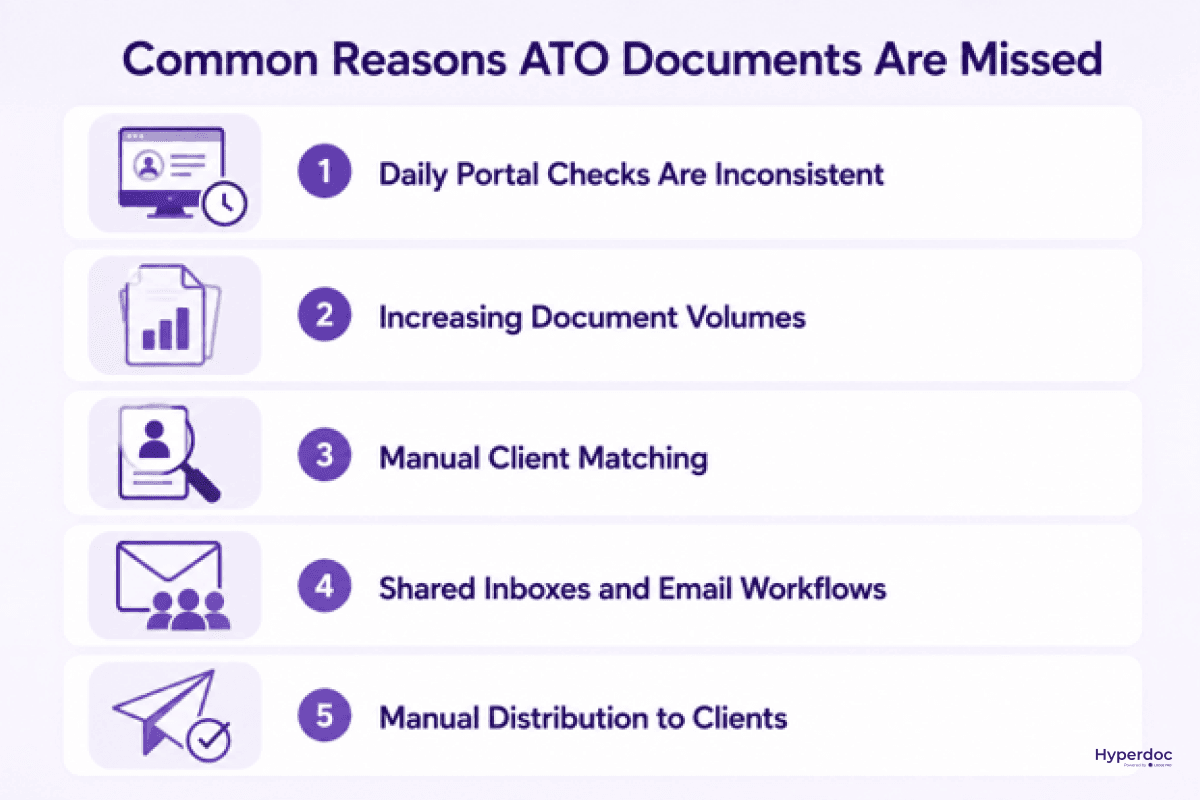
1. Daily Portal Checks Are Inconsistent
Many firms rely on staff logging into ATO portals each day to check for new correspondence.
However, daily routines can easily be disrupted by:
- peak lodgment periods
- annual leave
- sick leave
- competing client priorities
- staff turnover
If a portal is not checked consistently, important correspondence may remain unnoticed until a deadline has already passed.
2. Increasing Document Volumes
As accounting firms grow, so does the volume of ATO correspondence. A practice managing hundreds or even thousands of clients may receive a large number of notices every day. Without a structured workflow, documents can quickly accumulate, making it difficult for staff to identify which items require urgent attention.
3. Manual Client Matching
Once correspondence has been downloaded, staff must identify which client the document belongs to.
While this may sound straightforward, firms often manage.
- clients with similar names
- multiple entities
- trusts
- companies
- SMSFs
- family groups
Manual matching increases the possibility of documents being linked to the wrong client record.
4. Shared Inboxes and Email Workflows
Many firms continue to rely on shared email inboxes to manage incoming correspondence.
Although convenient, shared inboxes can introduce challenges such as:
- duplicate processing
- unclear ownership
- documents being overlooked
- inconsistent follow-up
- limited visibility into workflow progress
Without clear accountability, managers may struggle to determine whether a document has actually been reviewed or actioned.
5. Manual Distribution to Clients
Downloading a document does not complete the process. Staff must still prepare an email, attach the correct document, confirm the recipient, and send it securely.
Every manual step increases the potential for mistakes, including:
- sending documents to the wrong recipient
- attaching the wrong file
- forgetting to send the document altogether
- inconsistent communication between team members
The Business Impact of Missed ATO Correspondence
Missing an ATO document often creates additional work across multiple areas of the practice.
Some of the potential impacts include:
Delayed Client Responses
When ATO documents are not delivered promptly, clients may become aware of important notices later than expected, increasing the risk of missed payment deadlines, delayed actions, and unnecessary follow-up from your team. This can impact both client satisfaction and the overall efficiency of your practice.
Additional Administrative Work
Staff spend valuable time investigating:
- when the document arrived
- who downloaded it
- whether it was reviewed
- whether it was sent
- what action still needs to be taken
Reduced Client Confidence
Clients expect their accountant to manage important tax communications accurately and on time. Repeated delays, overlooked ATO correspondence, or inconsistent communication can reduce confidence in your firm's responsiveness and gradually weaken long-term client relationships.
Operational Inefficiencies
Instead of focusing on advisory services and other high-value client work, experienced staff often spend valuable time chasing routine administrative tasks, following up on document statuses, and manually managing ATO correspondence. This reduces productivity and limits the firm's capacity to grow.
Why Visibility Matters
One of the biggest limitations of manual workflows is the lack of visibility.
Practice managers often need answers to questions such as:
- Has this document already been reviewed?
- Who is responsible for this client?
- Has the correspondence been approved?
- Was it sent to the client?
- When was the client notified?
- Is there a record of every action taken?
When information is spread across emails, spreadsheets, and shared folders, answering these questions can take considerable time.
A structured workflow with clear document tracking provides greater transparency and accountability throughout the entire process.
Best Practices for Reducing the Risk of Missed Documents
While every accounting firm operates differently, several practices can help reduce the likelihood of overlooked ATO correspondence.
Establish Consistent Retrieval Processes
Checking ATO correspondence on a regular schedule helps ensure new documents are identified and processed promptly. A consistent retrieval process reduces delays, minimises the risk of overlooked notices, and keeps client communications moving efficiently.
Standardise Document Workflows
Creating consistent review, approval, and client communication procedures helps reduce variation between team members. Standardised workflows improve efficiency, minimise errors, and ensure every ATO document is processed consistently from retrieval to client delivery.
Reduce Manual Data Entry
Reducing the number of manual steps involved in processing ATO documents helps minimise the risk of human error, improve data accuracy, and save valuable administrative time. It also creates a more efficient and consistent workflow across your practice.
Maintain Clear Audit Records
Keeping a complete history of who accessed, reviewed, approved, and distributed each document ensures greater visibility throughout the workflow. This makes it easier to identify delays, investigate issues, and maintain consistent operational oversight.
Use Integrated Systems
Connecting practice management software with document workflows helps reduce duplicate data entry, improve data accuracy, and keep client information consistent across systems. This creates a more efficient workflow while reducing administrative effort.
Why More Firms Are Automating Their ATO Document Workflows
As accounting practices continue to grow, many are replacing manual administration with automated document workflows.
Automation does not replace professional judgement or client advice. Instead, it helps streamline repetitive administrative tasks that consume valuable staff time.
An automated workflow can assist with:
- retrieving new ATO correspondence as it becomes available
- matching documents to the correct client
- routing documents through review and approval stages
- maintaining document history and audit records
- reducing manual handling throughout the process
By reducing reliance on manual processes, firms can improve consistency while lowering the risk of missed correspondence.
How Hyperdoc Supports a More Reliable Workflow
Hyperdoc is an ATO document processing platform developed specifically for Australian accounting firms.
Rather than requiring staff to manually log into ATO portals throughout the day, Hyperdoc uses direct ATO integration to automatically retrieve new correspondence as it becomes available.
The platform also supports firms by:
- synchronising clients and contacts with Xero Practice Manager
- automatically matching correspondence to client records
- routing documents through structured review and approval workflows
- automatically redacting Tax File Numbers (TFNs) before review
- maintaining a complete audit trail of document activity
These capabilities help firms reduce repetitive administration while providing greater visibility over the entire ATO document processing workflow.
Learn how Hyperdoc can help your practice streamline ATO document processing.
Frequently Asked questions
Q1: Why does manual ATO processing create risks for accounting firms?
Manual ATO processing requires staff to retrieve, review, match, and distribute ATO correspondence using multiple manual steps. As document volumes grow, this increases the risk of human error, missed notices, and processing delays, making it harder for accounting firms to maintain an efficient and reliable workflow.
Q2: How do accounting admin bottlenecks affect productivity?
Accounting admin bottlenecks occur when repetitive administrative tasks, such as downloading ATO documents, matching clients, and preparing emails, consume valuable staff time. These bottlenecks reduce productivity, delay client communication, and prevent experienced accountants from focusing on higher-value advisory services.
Q3: What workflow inefficiencies are common in manual ATO document processing?
Common workflow inefficiencies include inconsistent portal checks, manual client matching, duplicate data entry, shared inbox management, and manual document distribution. These processes can create unnecessary administrative work, increase the likelihood of errors, and reduce visibility over document progress throughout the practice.
Q4: How can accounting firms reduce processing delays when managing ATO correspondence?
Reducing processing delays starts with implementing consistent document retrieval procedures, standardised review and approval workflows, integrated practice management systems, and automation where appropriate. Streamlining these processes helps firms improve turnaround times while reducing manual administration.
Q5: How can Hyperdoc help reduce workflow inefficiencies and manual ATO processing?
Hyperdoc helps Australian accounting firms reduce manual ATO processing, eliminate workflow inefficiencies, and minimise accounting admin bottlenecks by automatically retrieving ATO correspondence, synchronising with Xero Practice Manager, matching documents to client records, routing approvals, and maintaining a complete audit trail. This helps reduce processing delays while giving firms greater visibility over their entire ATO document workflow.