Loading...
August 7, 2026
How Accounting Firms Can Reduce ATO Debt and Director Penalty Notice Risk
Hyperdoc Team •Blog•5 min read
How Australian Accounting Firms Can Help Clients Stay Ahead of ATO Debt and Director Penalty Notices
Table of Contents
- How Accounting Firms Can Reduce the Risk of ATO Debt and Director Penalty Notices
- Why Early Action Makes All The difference
- The Hidden Challenge of Manual Document Management
- You Already Have Access to Your Clients' ATO Documents
- Helping Clients Stay Ahead Starts with Better Communication
- You Already Have Access to Your Clients' ATO Documents
- Automating ATO Document Processing with Hyperdoc
- Better Client Service Through Faster Communication
- Avoid Difficult Conversations Before They Happen
How Accounting Firms Can Reduce the Risk of ATO Debt and Director Penalty Notices
Managing tax compliance has become increasingly challenging for Australian businesses. As the Australian Taxation Office (ATO) continues to strengthen its debt recovery activities, accountants are playing a more important role than ever in helping clients avoid unnecessary penalties.
The Director Penalty Notice (DPN) is one of the most significant ones that corporate directors face today. A DPN may hold directors personally accountable for unpaid company tax payments, such as PAYG withholding, GST, and Superannuation Guarantee Charge liabilities.
While accountants cannot prevent all financial difficulties, they can significantly reduce the possibility of clients receiving Director Penalty Notices by ensuring that critical ATO communication is received, reviewed, and delivered on time.
Modern ATO document automation solutions help Australian accounting firms streamline this process, allowing accountants to focus on providing proactive advice instead of managing repetitive administration.
Why Early Action Makes All the Difference
Most businesses don't intentionally ignore their tax obligations.
Instead, problems usually begin because important ATO correspondence isn't seen quickly enough.
Documents such as:
- PAYG Instalment Notices
- Instalment Activity Statements (IAS)
- Activity Statements
- Payment reminders
- Debt notices
- Director Penalty Notices often require prompt action.
Some of these documents are sent directly to registered tax agents rather than appearing in a client's myGov account. If communication between the accounting firm and the client is delayed, payment deadlines can easily be missed.
By the time the client becomes aware of the issue, additional interest, penalties, or even a Director Penalty Notice may already have been issued.
This is why timely document processing has become an essential part of modern accounting practice.
The Hidden Challenge of Manual ATO Document Management
Many accounting firms still rely on manual processes to manage ATO correspondence.
A typical workflow often looks like this:
- Staff log into ATO portals throughout the day
- Documents are downloaded manually
- Files are renamed
- The correct client is identified
- Sensitive information is reviewed
- An email is prepared
- Documents are attached and sent
This process may seem manageable for smaller firms.
However, firms managing hundreds or thousands of clients quickly discover that manual document handling consumes a significant amount of administrative time.
During busy lodgment periods, even a single missed document can have serious consequences.
Helping Clients Stay Ahead Starts with Better Communication
One of the most valuable services accountants provide is keeping clients informed.
Clients rely on their accountant to notify them about:
- payment obligations
- lodgment deadlines
- outstanding balances
- ATO correspondence
- documents requiring immediate action
The faster clients receive these documents; the sooner they can make informed decisions.
Delays increase the likelihood of:
- overdue payments
- accrued interest
- penalties
- director liability
- damaged client relationships
Consistent communication helps clients stay compliant while building greater trust in your firm.
You Already Have Access to Your Clients' ATO Documents
As a registered tax agent, your practice already receives access to ATO correspondence for your clients.
The challenge isn't obtaining the documents. The challenge is processing them efficiently.
Without an effective ATO document management workflow, firms often struggle with:
- growing document volumes
- inconsistent processing
- staff leave
- multiple team members handling documents
- limited workflow visibility
Having the right system ensures every document follows a structured process from retrieval through to client delivery.
Supporting Growth Without Increasing Administration
As accounting firms grow, document volumes increase. Hiring additional administrative staff isn't always the most efficient solution. Instead, many firms are adopting automated ATO document processing to scale their operations without significantly increasing manual workloads.
With repetitive tasks handled automatically, accountants have more time for:
- client advisory services
- tax planning
- business strategy
- relationship management
- higher-value work
This creates a more scalable practice while improving the overall client experience.
Automating ATO Document Processing with Hyperdoc
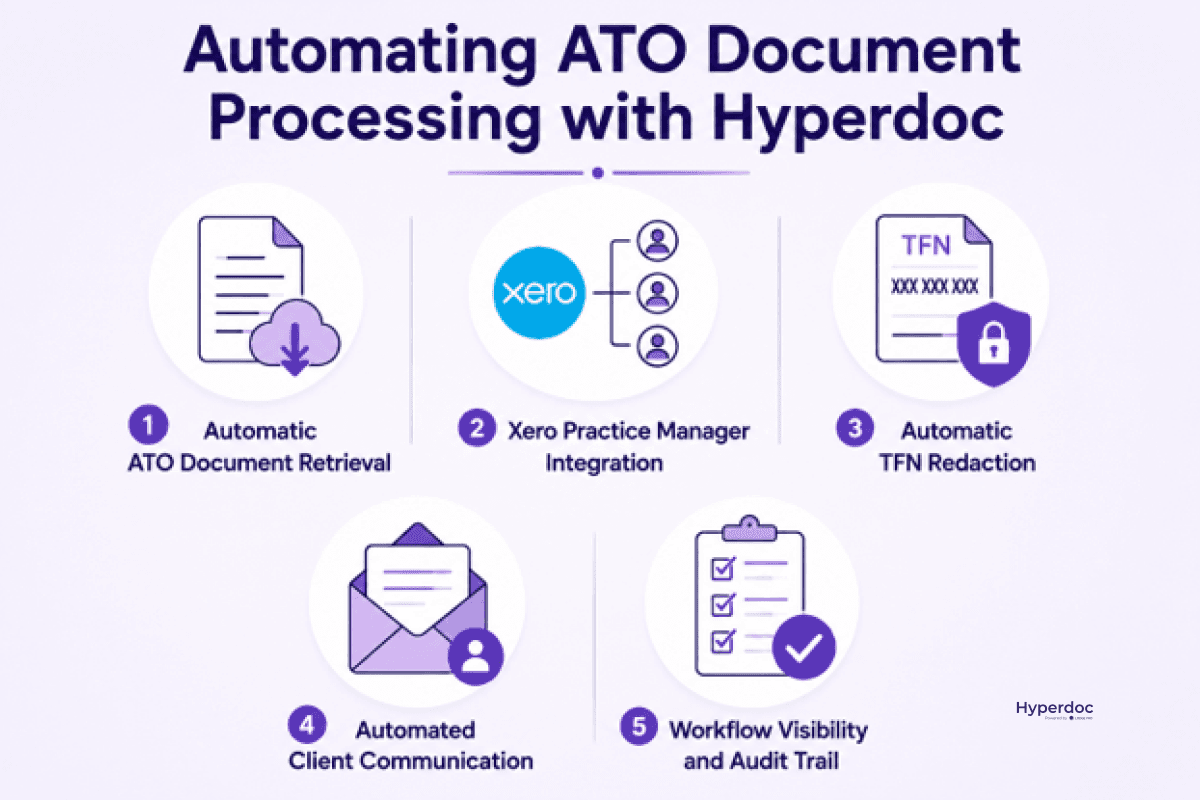 Hyperdoc is designed specifically for Australian accounting firms to simplify ATO correspondence automation.
Instead of relying on manual document handling, Hyperdoc automatically retrieves ATO correspondence and manages much of the administrative workflow.
Key capabilities include:
Automatic ATO Document Retrieval
Hyperdoc continuously retrieves ATO correspondence as it becomes available. Your team no longer needs to manually check ATO portals throughout the day. This reduces the chance of important notices being overlooked.
Xero Practice Manager Integration
Hyperdoc integrates with Xero Practice Manager, automatically synchronising client information. This reduces duplicate data entry and helps ensure documents are matched to the correct client.
Automatic TFN Redaction
Tax File Numbers are highly sensitive information. Hyperdoc automatically redacts TFNs from uploaded ATO documents before they are shared with clients, helping firms reduce privacy risks while maintaining efficient workflows.
Automated Client Communication
Preparing client emails manually can become repetitive when processing hundreds of documents each week. Hyperdoc extracts relevant information from ATO correspondence and automatically prepares client email drafts. Your team simply reviews the communication before sending, reducing administrative effort while maintaining complete control.
Workflow Visibility and Audit Trail
Knowing where every document is within the workflow is essential. Hyperdoc records every stage of document processing, including:
- retrieval
- review
- approval
- client delivery
This provides a complete audit trail, making it easy to answer questions such as:
- Has this document been reviewed?
- Who processed it?
- Has it been sent to the client?
- When was it delivered?
This operational visibility helps improve accountability while reducing internal confusion.
Visit our website to learn more about how Hyperdoc can help streamline your ATO document workflow.
Frequently Asked Questions
Q1. What is a Director Penalty Notice (DPN)?
A Director Penalty Notice (DPN) is issued by the Australian Taxation Office (ATO) and can make company directors personally liable for certain unpaid company tax debts, including PAYG withholding, GST, and Superannuation Guarantee Charge obligations.
Q2. How can accounting firms help clients avoid ATO debt?
Accounting firms can help by ensuring ATO correspondence is received promptly, communicating payment obligations quickly, monitoring outstanding notices, and using ATO document automation to reduce delays in processing.
Q3. Why is timely ATO document processing important?
Processing ATO documents quickly gives clients more time to respond to payment obligations, avoid penalties, discuss payment arrangements, and remain compliant with ATO requirements.
Q4. How does Hyperdoc automate ATO document processing?
Hyperdoc automatically retrieves ATO correspondence, synchronises client information with Xero Practice Manager, redacts Tax File Numbers (TFNs), prepares client email drafts, and tracks every stage of the document workflow with a complete audit trail.
Q5. Does Hyperdoc integrate with Xero Practice Manager?
Yes. Hyperdoc integrates with Xero Practice Manager (XPM) to synchronise client information, helping accounting firms reduce duplicate data entry and accurately match ATO documents to the correct clients.