Loading...
July 17, 2026
How Automation Helps During Tax Season: A Guide for Australian Accounting Firms
Hyperdoc Team•Blog•5 min read
How Automation Helps During Tax Season
Table of Contents
Introduction
Why Tax Season Creates So Much Administrative Work
The Hidden Cost of Manual ATO Document Processing
Simplify Tax Season With Hyperdoc
More Time for High Value Client Work
Book a Hyperdoc Demo Today
Introduction
Every Australian accounting business knows what happens during tax season. The volume of client work increases, deadlines tighten, inboxes overflow with ATO correspondence, and staff spend countless hours performing repetitive administrative activities rather than focusing on advising services.
While many businesses have invested in cloud accounting software, ATO document processing is still commonly done manually. Staff still use the ATO portal to download documents, rename files, redact Tax File Numbers (TFNs), send client emails, and update numerous systems.
When multiplied by hundreds or even thousands of clients, these simple chores represent one of the most significant productivity bottlenecks during tax season.
What is the good news? Automation is transforming the way Australian accounting businesses manage peak periods, allowing them to handle more work hiring more staff.
Why Tax Season Creates So Much Administrative Work
Tax season is more than just preparing tax returns. Firms also get a considerable rise in ATO correspondence, including:
Notices of Assessment (NOAs)
Activity Statement reminders
PAYG instalment notices
Debt notices
Superannuation correspondence
Compliance notifications
Client requests for ATO documents
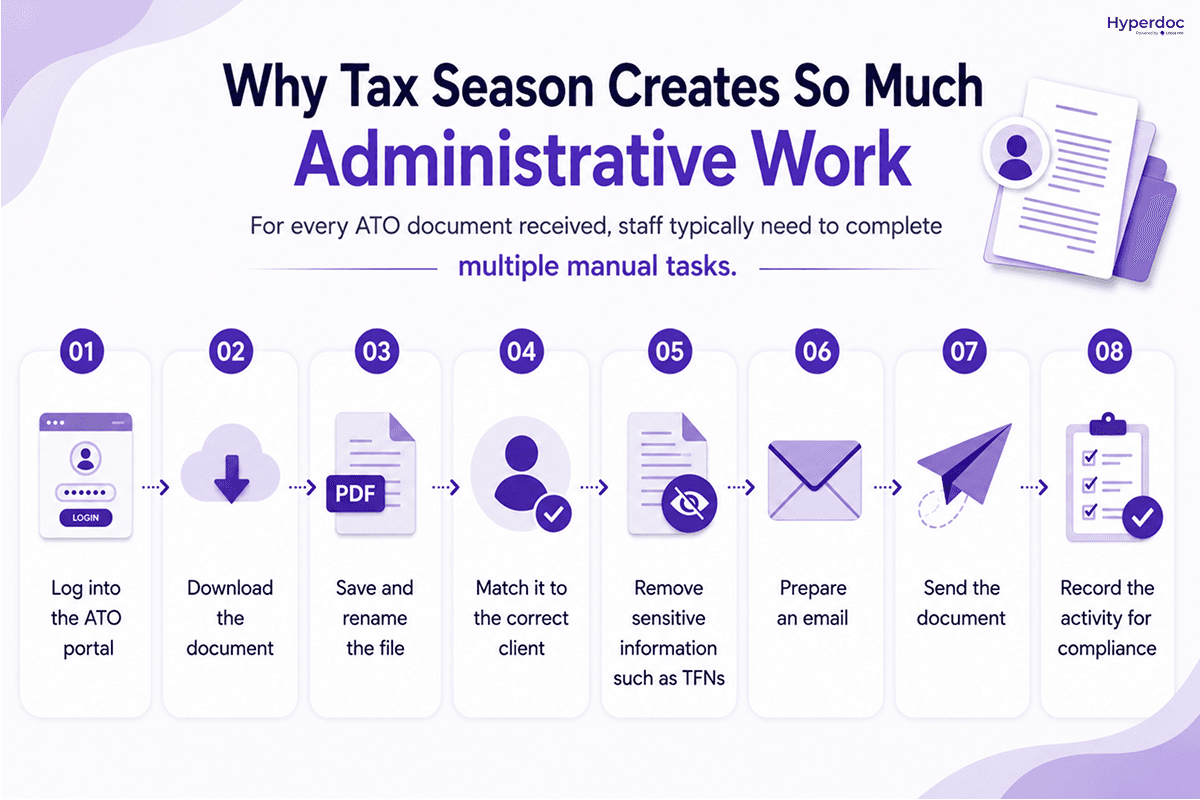
For every document received, staff typically need to:
Log into the ATO portal
Download the document
Save and rename the file
Match it to the correct client
Remove sensitive information such as TFNs
Prepare an email
Send the document
Record the activity for compliance
These tasks may only take a few minutes each, but when applied to hundreds of documents per week, they waste dozens of hours that could be spent providing higher-value client services.
The Hidden Cost of Manual ATO Document Processing
Most businesses just consider the obvious cost; staff time. However, manual workflows introduce new operational hazards.
Missed ATO Correspondence
When employees manually check the ATO site, crucial documents are often delayed or overlooked, especially during hectic hours.
Missing an ATO notice can have the following consequences:
Client responses were delayed.
Late payment
Issues of compliance
Negative client experience.
Duplicate Data Entry
Many accounting firms still enter the same client information into multiple systems, such as practice management software, document management platforms, and internal databases. This repetitive process consumes valuable time and adds unnecessary administrative work, particularly during the busy tax season.
Manually creating or updating client records across different systems also increases the risk of inconsistent or outdated information. Even small errors, such as incorrect client details or duplicate records, can lead to confusion, delays, and additional rework. As client numbers grow, these inefficiencies become even more difficult to manage, reducing overall productivity and limiting the time accountants can spend on higher-value client services.
Compliance Risks
Every document containing a Tax File Number (TFN) or other sensitive client information must be handled with care to meet Australian privacy and compliance requirements. When staff manually redact TFNs before sharing documents with clients, there is always a risk of human error.
A missed or incomplete redaction can expose confidential client information, potentially leading to privacy breaches, reputational damage, and compliance issues. During the busy tax season, when teams are processing hundreds of documents under tight deadlines, the likelihood of these errors increases even further.
Inconsistent Client Communication
During tax season, accounting firms send a large number of emails with ATO documents, reminders, and compliance updates. When each accountant sends their own emails, communication becomes inconsistent, making it difficult to provide a professional and consistent customer experience.
This could lead to:
Different phrasing and messaging within the team
Missing or incorrectly attached documents
Follow-up emails being ignored.
Inconsistent branding and tone of voice
A less professional and less reliable customer experience
Staff Burnout
Accounting teams are already under a lot of pressure during the busy season. When accountants spend hours performing repetitive administrative duties, productivity drops. Automation eliminates most of this admin work, freeing up accountants to focus on tasks that require professional expertise.
Simplify Tax Season with Hyperdoc
If your team is still spending hours every week downloading ATO documents, renaming files, redacting TFNs, and preparing client emails, it may be time to rethink your workflow.
Hyperdoc is purpose-built for Australian accounting firms and helps automate the entire ATO document management process.
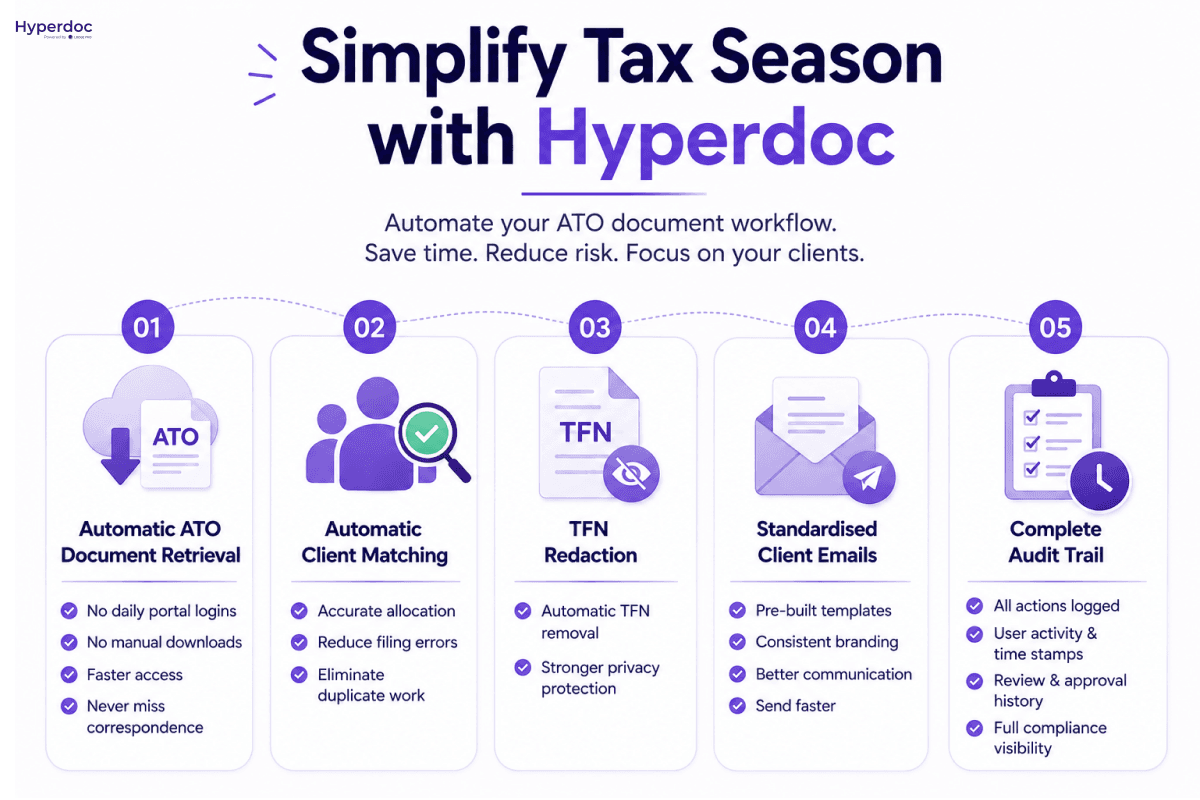
Hyperdoc provides:
Automatic ATO Document Retrieval
Instead of manually accessing the ATO portal each morning, Hyperdoc retrieves new ATO correspondence as it becomes available.
Benefits include:
No daily portal logins.
No manual downloads.
Faster access to documents
Reduced risk of missing correspondence
Automatic Client Matching
Rather than searching for the correct client every time a document arrives, Hyperdoc can allocate correspondence to the correct client automatically.
This reduces:
Manual searching
Filing errors
Duplicate work
TFN Redaction
Protecting client information is essential. Hyperdoc automatically removes TFNs before documents are shared externally, helping firms strengthen privacy controls while reducing manual handling.
Standardised Client Emails
During tax season, preparing hundreds of client emails can be repetitive.
Hyperdoc has pre-built email templates enabling accounting firms to:
Maintain consistent branding
Reduce typing
Improve communication quality
Send documents faster
Complete Audit Trail
Every action performed in Hyperdoc is immediately logged, giving your team comprehensive visibility into the whole document management process. Instead of attempting to remember who finished a task or sifting through email threads, you may get a complete, searchable history of each document.
Rather than asking:
Who sent me this document?
Has anyone reviewed this document?
When did it get approved?
Your team can immediately view:
User activity.
Time Stamps
Review the history.
Approval status
Customer communication
This thorough audit trail enhances responsibility, strengthens governance, and makes it much easier to establish compliance during internal or external audits. It also provides peace of mind by guaranteeing that every action is documented and easily traceable whenever necessary.
More Time for High-Value Work
Hyperdoc doesn't simply save time - it changes how your accounting firm operates.
Instead of spending hours processing paperwork, your accountants can focus on services that actually grow the practice, including:
Tax planning
Business advisory
Cash flow forecasting
Client meetings
Strategic planning
Business development
Instead of starting every morning with manual ATO downloads, your team can begin the day with documents already organised, assigned, and ready for review.
Ready To Get Started with Hyperdoc
Tax season will always be busy, but it doesn't have to be overwhelming.
Ready to streamline your ATO document workflow? Visit Hyperdoc to book a demo and discover how Hyperdoc can help your firm process ATO documents up to 90% faster, reduce administrative workload, and give your team more time to focus on delivering exceptional service to clients for just $100 with a 7-day free trial.
Frequently Asked Questions
Q1: What are the benefits of accounting automation?
The benefits of technology in accounting stem from the automation of repetitive operations. Accounting automation saves time, improves accuracy, reduces operational costs, increases security, and allows for quicker data access and clearer audit trails.
Q2: What is accounting automation?
Accounting automation software automates repetitive accounting operations such retrieving ATO documents, matching clients, processing documents, entering data, and communicating with clients. It enables accounting firms to increase efficiency, eliminate manual labor, and reduce errors.
Q3: Why is manual ATO document processing inefficient?
Manual document processing requires staff to log into the ATO portal, download files, rename documents, redact TFNs, prepare emails, and update multiple systems. These repetitive tasks consume valuable time and increase the risk of errors.
Q4: How does Hyperdoc help Australian accounting firms?
Hyperdoc automates the entire ATO document management workflow by retrieving ATO correspondence, automatically matching documents to clients, redacting TFNs, providing standardised email templates, and maintaining a complete audit trail. This helps firms process ATO documents faster while reducing administrative workload.
Q5: Will accounting automation replace accountants?
No. Automation replaces repetitive administrative tasks rather than professional expertise. It enables accountants to focus on higher-value services such as tax planning, business advisory, client relationships, and strategic decision-making.